How to Order Wine in San Sebastián: Spanish & Basque Bar Terms (2026 Guide)
Wine is vino in Spanish and ardoa in Basque. Learn txakoli, txikito, crianza and zurito, pour sizes, 2026 bar prices and a pocket phrase card for San Sebastián.
Quick answer
- Wine = vino (Spanish, VEE-noh) = ardoa (Basque, ar-DOH-ah).
- Red = tinto / ardo beltza · White = blanco / ardo zuria · Rosé = rosado / ardo gorria.
- The local order: “Un txakoli, por favor” (chah-koh-LEE), the Basque Country’s lightly sparkling white, poured from a height.
- Small glass of wine: un txikito (chee-KEE-toh) · Small beer: un zurito (thoo-REE-toh).
- Want an aged red? Say the category, not just the region: “un crianza” or “un reserva.”
- Pay at the end: “¿Qué te debo?” or, in Basque, “Kontua, mesedez.” Tipping isn’t expected; rounding up is enough.
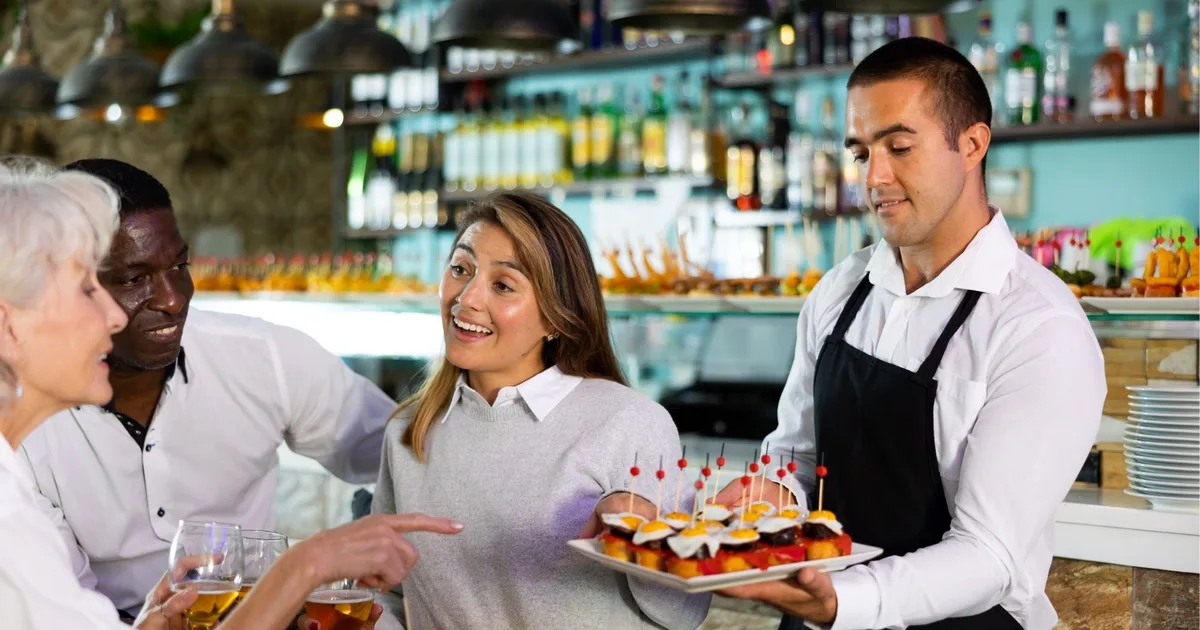
The first time at a packed bar in San Sebastián’s Parte Vieja can feel like an exam: people twelve deep, a chalkboard written in two languages, and a bartender looking straight at you. Ordering wine here takes about six words, and locals use even fewer. This guide covers those words in Spanish and Basque (Euskara), how big your glass will be, what the wine list means, what you should pay in 2026, and the mistakes that mark you out as a first-timer.
Check Availability
Wine in Spanish and Basque: the core vocabulary
Spanish (castellano) and Basque are both official here, and you’ll see both on menus and street signs. Basque isn’t related to Spanish, or to any other living language, so don’t try to work words out from Spanish. Everyone in a San Sebastián bar speaks Spanish. A Basque kaixo or eskerrik asko still gets a noticeably warmer smile.
Pronunciation in one line: in Basque, tx = “ch”, x = “sh”, z = a soft “s”, and every vowel is said clearly. In Spanish (Castilian), z and ce/ci sound like “th”, and ll is close to “y”.
| English | Spanish | Basque (Euskara) | Say it (Spanish / Basque) |
|---|---|---|---|
| Wine | vino | ardoa | VEE-noh / ar-DOH-ah |
| Red wine | vino tinto | ardo beltza (lit. “black wine”) | TEEN-toh / AR-doh BELT-sah |
| White wine | vino blanco | ardo zuria | BLAHN-koh / AR-doh SOO-ree-ah |
| Rosé | vino rosado | ardo gorria (lit. “red wine”) | roh-SAH-doh / AR-doh GOH-rree-ah |
| Sparkling wine | espumoso / cava | ardo aparduna | es-poo-MOH-soh / ah-par-DOO-nah |
| Sweet | dulce | gozoa | DOOL-theh / goh-SOH-ah |
| Dry | seco | lehorra* | SEH-koh / leh-OH-rrah |
| Young wine | joven | ardo gaztea | HOH-ven / gahs-TEH-ah |
| House wine | vino de la casa | etxeko ardoa* | deh lah KAH-sah / eh-CHEH-koh |
| By the glass | por copas | — | por KOH-pahs |
| A glass of wine | una copa de vino | ardo bat | OO-nah KOH-pah |
| Bottle / half bottle | botella / media botella | botila / botila erdia | boh-TEH-yah / boh-TEE-lah |
| Txakoli | txakoli / chacolí | txakolina | chah-koh-LEE / chah-koh-LEE-nah |
| Cider | sidra | sagardoa | SEE-drah / sah-gar-DOH-ah |
| Cheers! | ¡Salud! | Topa! | sah-LOOD / TOH-pah |
*Common usage, not confirmed in a dictionary. In practice, ask for house wine in Spanish.
The colour trap: Basque describes wine colour differently from English. Red wine is beltza, “black”. Rosé is gorria, the everyday word for “red”. So if you ask for ardo gorria expecting a Rioja, you’ll get a pink wine.
The Basque bar dictionary: txikito, zurito, pote and more
These words aren’t in your phrasebook, but you’ll hear them every evening.
- Txikito (chee-KEE-toh): a short glass of wine, traditionally red, served in a small, wide tumbler. It comes from txiki, “small”. Going from bar to bar with your cuadrilla (friends’ group) for a txikito at each stop is called txikiteo. Each friend pays for a round.
- Zurito (thoo-REE-toh): half a glass of draught beer, about 100–150 ml, served in that same txikito tumbler. The story goes that Carlos Pérez Garrido, a Donostia man, got tired of rough wine in the 1960s and started ordering small beers on the txikiteo instead. He died in 2018. Locals still ask for a zurito when they want to go easy.
- Caña (KAH-nyah): a standard draught beer, roughly 200–250 ml. Donostia cañas are often generous. Elsewhere in Spain a small beer is a corto; here, say zurito.
- Pote (POH-teh): any drink, in casual speech. Over time, txikitos became potes, and that gave rise to…
- Pintxo-pote: a weekly deal where participating bars sell a set pintxo plus a drink (usually a zurito, a caña or a house wine) for one low price, on one fixed evening a week. Details below.
- Un crianza / un reserva / un rioja / un ribera: shorthand for an aged red, or for a red from a named region, by the glass. Locals rarely say vino: “Un crianza, por favor.”
- Un txakoli: the default local white. Most of what you’ll drink in San Sebastián comes from the Getaria DO, a short drive west along the coast.
- Kalimotxo (kah-lee-MOH-choh): red wine and cola, half and half, over ice. It’s a fiesta and student drink, not something to order with a pintxo at a serious counter. More on how it got its name in 1972 below.
- Mosto (MOHS-toh): unfermented grape juice, the traditional non-alcoholic option, in red or white. In Basque, mostua.
- Escanciar (es-kahn-THYAR): to pour from a height. It’s done with cider and Getaria txakoli to wake up the bubbles.
- Txotx (chotch): the call in a cider house (sagardotegi) when the barrel tap opens. Everyone gets up and catches a few fingers of cider in their glass. Cider season runs from mid-January to about April; our Basque cider houses guide covers the houses, the menu and the buses.
Wine pour sizes and glasses: how much you get
Spain sets no legal pour size for wine by the glass. What you get depends on the bar’s glass and habits, but the norms are fairly consistent.
| Drink | Glass | Typical pour | Notes |
|---|---|---|---|
| Txikito / chato | Short, wide tumbler | ~100–120 ml | The classic old-town red; cheap and small by design |
| Copa de vino (standard glass) | Stemmed wine glass | ~125–150 ml | 125 ml = 6 glasses per bottle; 150 ml = 5 |
| Txakoli (Getaria style) | Wide, flat-bottomed tumbler, or a copa | ~70–100 ml, poured from ~20 cm | Small pours, refilled often, so it stays cold and lively |
| Zurito | Txikito tumbler | ~100–150 ml | Half a caña |
| Caña | Small beer glass | ~200–250 ml | Often generous in Donostia |
| Txotx (cider house) | Wide cider glass | 2–3 fingers | Drink it at once, then go back for more |
| Standard drink unit (Spain) | — | 100 ml of 12% wine ≈ 10 g alcohol | The unit Spanish health authorities use |
Bottle sizes on a wine list: botella = 75 cl. Media botella = 37.5 cl, which is rare in pintxo bars and more common in restaurants. Magnum = 1.5 l, two bottles’ worth, sometimes seen at asadores and celebrations.
Why txakoli is poured from a height
Getaria txakoli is bottled with a little natural carbon dioxide, which gives it a gentle prickle. Bartenders hold the bottle high, about 20 cm above the glass according to producers such as Txakoli Katalin Iturzaeta in Getaria. The splash releases the bubbles (locals call this the txinparta) and opens up the citrus and sea-spray aromas. A wide, flat glass gives the wine room to land and froth. The pour is small because the fizz fades quickly: drink it while the foam is still on the surface, then order another.
Insider detail: the Getariako Txakolina regulatory council’s own website (getariakotxakolina.eus) says “we recommend serving it en copa”, in a stemmed glass, at 6–10 °C. So the high pour into a tumbler is bar tradition, not a rule, and smarter restaurants increasingly use proper wine glasses. Txakoli from Bizkaia and Álava is usually less fizzy and is normally served without the theatrical pour.
How to read a Spanish wine list (carta de vinos)
A Spanish wine list (carta de vinos) is usually arranged by colour (tintos, blancos, rosados, espumosos, dulces), then by region, and often by age category within each region. Prices are given for a glass (copa) and a bottle (botella). In pintxo bars there may be no printed list, just bottles lined up behind the bar or a chalkboard headed vinos por copas.
The labels: DO, DOCa and the regions you’ll see
| You’ll see | What it means | Local tip |
|---|---|---|
| DOCa Rioja | Spain’s first “qualified” designation (1991); mostly Tempranillo-based reds | The vineyards are under two hours’ drive away, and Rioja is the house red of the Basque Country |
| Rioja Alavesa | The Basque (Álava) slice of Rioja, now labelled as a Vino de Zona | Order it to drink “Basque” red |
| Getariako Txakolina | Txakoli DO of Gipuzkoa (recognised 1989); the Basque Government puts Hondarrabi Zuri at 95% of the vineyard, while the DO’s January 2026 figures (via Vinetur) give 85% Hondarrabi Zuri and 10% Hondarrabi Beltza across 479 ha | The default “un txakoli” in San Sebastián (Basque wine guide) |
| Bizkaiko Txakolina | Txakoli from Bizkaia (Bilbao side) | Often rounder, less fizzy |
| Arabako Txakolina | Txakoli from Álava (DO since 2001) | Rarer; order it if you see it listed |
| Navarra | Neighbouring region; good rosado and Garnacha | Great-value rosé |
| Ribera del Duero | Powerful Tempranillo (“Tinto Fino”) from Castilla y León | “Un ribera” is the classic alternative to “un rioja” |
| Rueda | Crisp Verdejo whites | The most common non-txakoli white by the glass |
| Rías Baixas | Albariño from Galicia | Superb with seafood pintxos (pairing chart) |
Age categories: the words that change the price
| Label | Red wine minimum (Rioja rules) | White/rosé minimum (Rioja) | What it tastes like |
|---|---|---|---|
| Joven / Genérico (or no age term) | No minimum | No minimum | Fresh, fruity, cheapest |
| Crianza | 2 years total, at least 1 in oak | 18 months, 6 in oak | Fruit plus a little vanilla and spice; the everyday aged red |
| Reserva | 3 years, at least 1 in oak and 6 months in bottle | 2 years, 6 in oak | Smoother, more savoury |
| Gran Reserva | 5 years, at least 2 in oak and 2 in bottle | 4 years, 6 in oak | Mellow, leathery, special-occasion |
Other DOs set their own rules within national minimums. For example, a national red Crianza needs only 6 months in oak, while Rioja and Ribera del Duero require 12. In practice the hierarchy reads the same everywhere. If you want to taste the difference for yourself, our wine tasting for beginners guide shows how to compare a crianza and a reserva side by side.
The newer Rioja terms: pueblo and viñedo singular
Since 2017, Rioja has added a place-based ladder alongside the age-based one:
- Vino de Zona: from one subzone, Rioja Alta, Rioja Alavesa or Rioja Oriental.
- Vino de Pueblo: from one of Rioja’s 144 villages. It was called Vino de Municipio until February 2024.
- Viñedo Singular: a single, officially approved plot. Vines must be at least 35 years old and hand-harvested, yields are lower, and the wine must pass tasting panels.
A bottle can carry both a place and an age category, e.g. a Rioja Alavesa Reserva. If you see Viñedo Singular by the glass, order it; the bars in our best wine bars guide are where you’re most likely to find one.
Grapes you’ll meet
- Reds: Tempranillo (the backbone of Rioja), Garnacha (juicy, berry-ish), Graciano (perfumed, high-acid), Mazuelo (also called Cariñena; adds colour and bite), Hondarrabi Beltza (txakoli’s red grape).
- Whites: Hondarrabi Zuri (txakoli), Viura (also called Macabeo; white Rioja), Verdejo (Rueda), Albariño (Rías Baixas).
Cosechero and maceración carbónica
In Rioja Alavesa, look for vino de cosechero (the “harvester’s wine”), also labelled maceración carbónica. Whole bunches ferment in their own carbon dioxide, which gives a bright, purple, very fruity young red. It was how most Rioja was made before Bordeaux-style methods arrived in the 19th century. Cold, cheap and easy to drink, it’s the closest thing to a red txakoli.
How to order at a pintxo bar, step by step
- Get in and get seen. Squeeze politely to the counter. Locals do. Catch the bartender’s eye or give a small raised hand. Don’t whistle or wave money. A cheerful “¡Hola!” or “Kaixo!” is enough.
- Order your drink first. Keep it short: “Un txakoli y un crianza, por favor.” That’s a complete, polite sentence here.
- Choose your pintxos. Point at the counter, or ask for a plate and help yourself if others are doing it. Then look at the chalkboard: the best things are often hot pintxos (pintxos calientes or de cocina) cooked to order. Ask: “¿Qué me recomiendas de la pizarra?”
- Ask for the local pick. “¿Qué txakoli tienes?” or “¿Qué me recomiendas?” Bartenders enjoy being asked, and you’ll often get something better than the default.
- Eat standing, one or two per bar. Locals eat one or two pintxos with one drink, then move on. Sitting down is fine, but standing at the bar is the ritual.
- Keep track and pay at the end. Many bars keep a running tab and trust you to say what you had: “Dos txakolis, un pintxo de anchoa y una gilda.” Some busy old-town bars now take payment as you order. If unsure, ask: “¿Pago ahora o al final?”
- Tip lightly or not at all. Tipping isn’t expected. Leaving the coins or rounding up is normal. In a sit-down restaurant, 5–10% for great service is generous.
- Say goodbye. “Agur!” or “Eskerrik asko!” on the way out, then on to the next bar.
Bar vs restaurant, and ordering a bottle to share
At a pintxo bar, drinks are ordered by the glass, one round at a time. Ordering a bottle at the counter is possible, but it ties you to one bar, which defeats the point of a crawl. Save bottles for sit-down meals at a restaurant, asador or cider house. Ask for the wine list, “¿Me trae la carta de vinos?”, and you’ll be shown the bottle and given a taste. Sending wine back is acceptable only if it’s faulty (corked, oxidised or vinegary), not because you don’t like the style. Say: “Perdone, creo que este vino no está bien.”
Pintxo-pote: when and where (2026)
| Area | Typical night | Typical price | Notes |
|---|---|---|---|
| Gros | Thursday, ~19:30–22:30 | ~€3.50 | The biggest and busiest: Zabaleta, Bermingham, Plaza Cataluña, Karkizano |
| Amara | Wednesday–Friday | ~€2.50 (Amara Viejo) | Isabel II and Balleneros streets |
| Egia | Usually Friday | ~€2.50–3 | Very local, neighbourhood feel |
| Antiguo | Wednesday or Thursday (varies) | ~€2.50–3 | Around Calle Matia |
| Parte Vieja | Rare | — | The old town mostly doesn’t do it |
San Sebastián Turismo puts a pintxo-pote at about €2.50 in Amara Viejo and €3.50 in Gros, where the pintxos are more elaborate. Sources disagree on the night in Egia and Antiguo, and bars change their nights by season, so check on the day. Pintxo-pote pintxos are often smaller or simpler than the regular ones; that’s how bars make it work. Go for the street atmosphere, not for gastronomy.
What wine costs in San Sebastián bars (2026)
| Drink | Typical everyday bar | Famous / upscale | Confidence |
|---|---|---|---|
| Txikito / house red | €1.80–3 | €3–4 | Medium (traveller reports) |
| Glass of txakoli | €2.50–4 | €4–7 (hotel terraces €6–10) | Medium |
| Glass of Rioja crianza | €3–4.50 | €4.50–7 | Low (estimate) |
| House wine (copa) | €2.50–4 | €4–6 | Medium |
| Zurito | €2–2.50 | ~€2.20+ on terraces | Medium |
| Caña | €2.50–3 | €3–4 | Medium |
| Bottle of Getaria txakoli (restaurant) | €18–25 | €25–40 | Low (retail is ~€8–18) |
| Pintxo-pote (pintxo + drink) | €2.50–3.50 | — | Medium-high (official tourism site) |
| Pintxo | €2.50–3.50 | €4–10 | Medium |
No consumer survey covers bar drink prices in Donostia, so these ranges combine the official tourism site’s pintxo-pote figures, dated traveller reports and local blogs. Read them as estimates. Prices here have risen sharply: in April 2024, Noticias de Gipuzkoa wrote that the days when a zurito could cost one euro and a caña two euros are gone. Expect the Parte Vieja and terraces to cost more than Gros, Egia or Amara. A typical 3–4 bar evening with one pintxo and one drink per stop costs about €25–40 per person.
Common mistakes tourists make
- Ordering sangria in a pintxo bar. Some bars will make it for tourists, but locals drink txakoli, wine, vermouth, cider or beer. Ask for sangria and you’re paying more for a worse drink.
- Ordering “a Rioja” without a category. You’ll get whatever is open, often a joven. Say crianza, reserva or a producer’s name.
- Saying “un vino” and stopping there. The bartender will ask “¿Tinto o blanco?”, so get ahead of it. “Un blanco” might get you a Rueda Verdejo rather than txakoli. If you want txakoli, say txakoli.
- Confusing sin with sin gluten. “Una sin” means alcohol-free beer, which almost every bar has. Gluten-free beer is “cerveza sin gluten”, and it’s a different product. If you’re coeliac, say it in full; our gluten-free and alcohol-free guide has the full phrase list.
- Asking for pitchers, or ordering big rounds. Jugs and pints aren’t part of the culture. Small and often is the rhythm.
- Asking for ardo gorria expecting red. That’s rosé. Red is ardo beltza.
- Treating one bar as dinner. Piling a plate high at one counter misses the point. Go on to the next bar.
- Waiting for the bill to arrive. Nobody brings it. Ask for it.
Fun facts
- Kalimotxo got its name, and took off, on 12 August 1972 at the San Nicolás fiestas in Algorta’s Puerto Viejo, near Bilbao. The organisers, the Antzarrak cuadrilla, had 2,000 litres of red wine that had gone off. They rescued it by mixing it with cola, which turned it into 4,000 litres of kalimotxo, and named the result after a friend nicknamed “Kali” plus motxo, which they took to mean “ugly”. Red wine and cola had been mixed in Spain since the 1920s, but the 1972 batch gave it its name and its fame.
- Basque is a language isolate. It isn’t related to Spanish, French or any other living language, which is why ardoa looks nothing like vino.
- A tiny DO with a big reputation. The Basque Government puts Hondarrabi Zuri at 95% of the vineyard in the Getariako Txakolina DO, though the DO’s January 2026 figures (via Vinetur) give 85%. The DO originally covered Getaria, Zarautz and Aia and was extended to all of Gipuzkoa in 2007.
Pocket phrase card (print me)
| English | Spanish | Basque | Say it |
|---|---|---|---|
| Hello | Hola | Kaixo | OH-lah / KAI-shoh |
| Please | Por favor | Mesedez | por fah-VOR / meh-SEH-des |
| Thank you | Gracias | Eskerrik asko | GRAH-thyahs / es-keh-REEK AHS-koh |
| Excuse me | Perdone | Barkatu | per-DOH-neh / bar-KAH-too |
| A glass of red, please | Un tinto, por favor | Ardo beltz bat, mesedez | oon TEEN-toh |
| A glass of white | Un blanco | Ardo zuri bat | oon BLAHN-koh |
| A rosé | Un rosado | Ardo gorri bat | oon roh-SAH-doh |
| A txakoli, please | Un txakoli, por favor | Txakoli bat, mesedez | oon chah-koh-LEE |
| A small glass of wine | Un txikito | Txikito bat | oon chee-KEE-toh |
| A small beer | Un zurito | Zurito bat | oon thoo-REE-toh |
| A crianza red | Un crianza | — | oon kree-AHN-thah |
| Two more, please | Dos más, por favor | Beste bi, mesedez | dohs MAHS |
| Which txakoli do you recommend? | ¿Qué txakoli me recomiendas? | — | keh chah-koh-LEE meh reh-koh-MYEN-dahs |
| What’s the local wine? | ¿Cuál es el vino de aquí? | — | kwahl es el VEE-noh deh ah-KEE |
| By the glass? | ¿Por copas? | — | por KOH-pahs |
| A bottle, please | Una botella, por favor | Botila bat, mesedez | OO-nah boh-TEH-yah |
| The wine list, please | La carta de vinos, por favor | Ardo karta, mesedez* | lah KAR-tah deh VEE-nohs |
| What’s on the chalkboard? | ¿Qué hay en la pizarra? | — | keh AI en lah pee-THAH-rrah |
| A hot pintxo, please | Un pintxo caliente | — | oon PEEN-choh kah-LYEN-teh |
| Alcohol-free beer | Una sin | — | OO-nah SEEN |
| Gluten-free | Sin gluten | Glutenik gabe | seen GLOO-ten |
| Water | Agua | Ura | AH-gwah / OO-rah |
| Grape juice (non-alcoholic) | Mosto | Mostua | MOHS-toh |
| Cheers! | ¡Salud! | Topa! | sah-LOOD / TOH-pah |
| Enjoy your meal | Que aproveche | On egin | keh ah-proh-VEH-cheh / ohn EH-geen |
| Do I pay now or at the end? | ¿Pago ahora o al final? | — | PAH-goh ah-OH-rah oh al fee-NAHL |
| What do I owe you? | ¿Qué te debo? | Zenbat da? (How much is it?) | keh teh DEH-boh / SEN-bat dah |
| The bill, please | La cuenta, por favor | Kontua, mesedez | lah KWEN-tah / kon-TOO-ah meh-SEH-des |
| Goodbye | Adiós | Agur | ah-DYOHS / ah-GOOR |
*Not confirmed in a dictionary; the Spanish version always works.
Sample dialogue at a pintxo bar
You: ¡Kaixo! Un txakoli y un crianza, por favor.
Bartender: ¡Venga! ¿Algo de comer? (Sure! Anything to eat?)
You: Sí. ¿Qué me recomiendas de la pizarra? (Yes. What do you recommend from the board?)
Bartender: La carrillera está muy buena hoy. (The beef cheek is very good today.)
You: Perfecto, una carrillera. Y una gilda. (Perfect, one beef cheek. And a gilda.)
…ten minutes later…
You: ¿Qué te debo? Dos vinos, una carrillera y una gilda. (What do I owe you? Two wines, a beef cheek and a gilda.)
Bartender: Son trece con cincuenta. (That’s €13.50.)
You: Tori. Eskerrik asko, agur! (Here you go. Thanks, bye!)
Frequently asked questions
How do you say wine in Spanish?
Wine is vino (VEE-noh). Red wine is vino tinto, white is vino blanco, rosé is vino rosado and sparkling is espumoso (or cava). In bars, Spaniards usually drop vino and just say un tinto or un blanco.
How do you say wine in Basque?
Wine is ardoa (ar-DOH-ah). Red is ardo beltza (literally “black wine”), white is ardo zuria and rosé is ardo gorria (literally “red wine”). Spanish is understood everywhere in San Sebastián, but a Basque word or two is appreciated.
What is txakoli and how do you pronounce it?
Txakoli (chah-koh-LEE) is a dry, low-alcohol (at least 9.5% under the Consejo Regulador’s rules, usually 10.5–11.5%), lightly sparkling white wine from the Basque Country. It’s made mainly from the Hondarrabi Zuri grape. In San Sebastián it’s usually Getariako Txakolina, poured from a height into a wide glass.
What is a txikito?
A txikito is a small glass of wine, traditionally red, served in a short, wide tumbler. Going from bar to bar drinking txikitos with friends is called txikiteo. The same glass is used for a zurito, a small beer.
What’s the difference between crianza, reserva and gran reserva?
They are minimum ageing times. In Rioja, a red Crianza is aged at least 2 years (1 in oak), a Reserva at least 3 years (1 in oak, 6 months in bottle) and a Gran Reserva at least 5 years (2 in oak, 2 in bottle). Older usually means smoother, more savoury and more expensive.
How much wine is in a glass in Spain?
There’s no legal standard. A bar copa is usually about 125–150 ml, and a traditional txikito or chato about 100–120 ml. Txakoli is poured in smaller amounts so it stays cold and fizzy.
Why is txakoli poured from a height?
Pouring from about 20 cm above the glass releases the wine’s light natural carbonation and lifts its aromas. That’s also why it’s served in small pours in a wide, flat glass and drunk quickly.
How much does a glass of wine cost in San Sebastián in 2026?
In a typical pintxo bar, expect about €2.50–4 for txakoli or house wine and €3–4.50 for a Rioja crianza. Famous Parte Vieja bars and terraces charge more. A pintxo-pote deal costs about €2.50–3.50.
When is pintxo-pote in San Sebastián?
Thursday evening in Gros (about 19:30–22:30) is the biggest. Amara runs Wednesday to Friday, and Egia usually on Friday. Participating bars offer a pintxo and a drink for one set price, typically €2.50–3.50.
Do you tip in San Sebastián bars?
Tipping isn’t expected in pintxo bars. Locals leave small change or round up. In sit-down restaurants, 5–10% is generous for great service.
Do I pay as I go or at the end in a pintxo bar?
Traditionally you pay at the end, telling the bartender what you had. Some busy old-town bars now ask you to pay when you order. If unsure, ask “¿Pago ahora o al final?”
Is kalimotxo Basque?
Yes. Wine-and-cola mixes existed earlier, but the name and its popularity date from 12 August 1972, at the San Nicolás fiestas in Algorta (Getxo, Bizkaia), when organisers rescued 2,000 litres of spoiled red wine by mixing it with cola, turning it into 4,000 litres of kalimotxo.
Taste it with a local
Words get you served. A guide gets you the right glass at the right bar, with the right pintxo. Devour’s Pintxos and Wine Tour spends three hours in five Old Town bars, with eight pintxos and four drinks: it starts with dry Basque cider and the high pour, takes in a local sparkling wine with the anchovies, and finishes with a dessert sherry. It costs from $120 and is rated 4.8/5 from more than 640 reviews (our breakdown). If you’d rather compare wines from different Spanish regions, the pintxo tasting paired with wines pours three of them, plus a Basque cider and a local liqueur, with eight pintxos, from $121.
Keep reading:
Eat the Parte Vieja Like a Local — In One Evening
Eight pintxos, four drinks and five Old Town bars, chosen by a guide who knows which counter to stand at. Rated 4.8/5 by 649 guests. Free cancellation up to 24 hours before.
Check Availability & Book