Basque Cider Houses near San Sebastián: The 2026–27 Guide to Txotx Season
What Basque cider is, when txotx season opens in 2027, the best cider houses near San Sebastián, 2026 menu prices, buses and how to catch the jet from the barrel.
Quick answer
- What it is: Basque cider (sagardoa) is a still, dry, tart, unfiltered cider of about 6% ABV, poured from a height to wake up its natural bubbles. You drink it in a sagardotegi (cider house), where you eat a fixed menu of cod omelette, cod with peppers, txuleta steak and Idiazabal cheese, and get up to catch cider straight from huge barrels whenever someone shouts “Txotx!”.
- Season: mid-January to late April or early May. The 2026 season opened on 14 January 2026. The 2027 opening is expected around 13 January 2027 (not yet confirmed).
- Where: Astigarraga and Hernani, 15–30 minutes from central San Sebastián on the €1.95 BU12/BU13 bus.
- Cost: about €44–47 per adult in 2026, unlimited cider included.
- Our pick: Petritegi in Astigarraga. It is open almost all year, its farmhouse is 500 years old, and it offers children’s, vegan and gluten-free options.
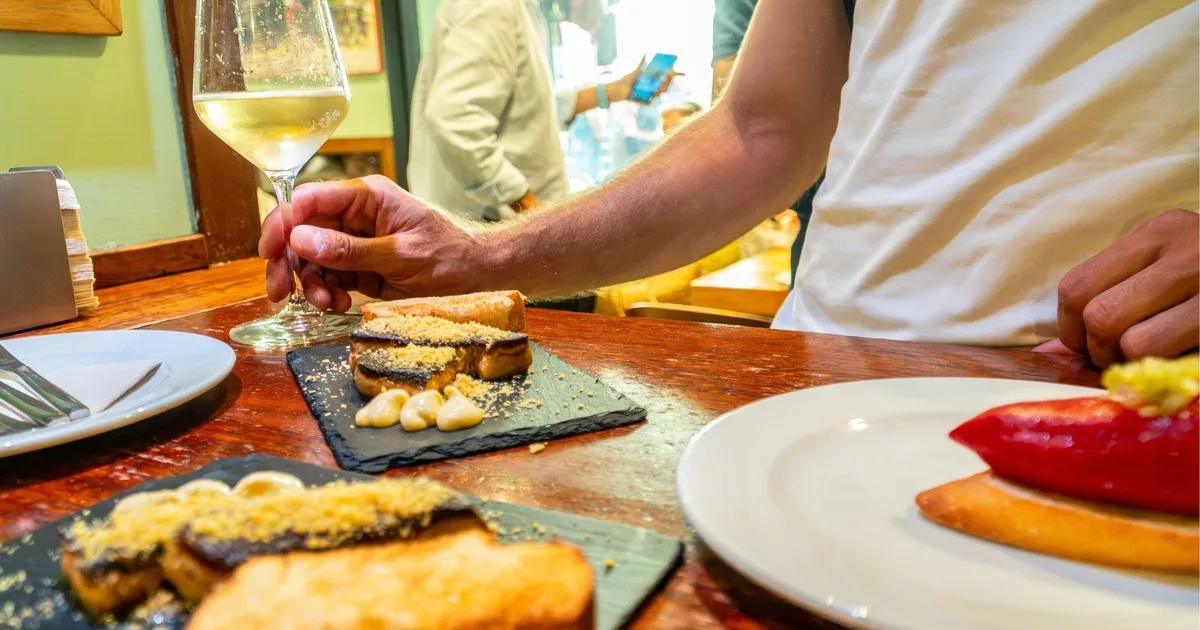
Every January, when the Tamborrada drums are still echoing round the Old Town, the people of San Sebastián start asking each other one question: “Sagardotegira noiz?”, meaning “When are we going to the cider house?” For about four months, groups of friends, office teams, rugby clubs and grandmothers’ birthday parties pile onto buses to the apple country just south of the city. They eat far too much steak and shout at barrels. It is the most joyful meal of the Basque year.
This guide covers what Basque cider is, how it differs from the cider you know and from wine, how the txotx ritual works, and which cider houses we recommend for 2026–27, with prices, booking tips and how to get home safely.
Check Availability
What is Basque cider (sagardoa)?
Sagardoa comes from sagar (apple) and ardo (wine), so it is literally “apple wine”. It is made by crushing and pressing local apples in autumn, then leaving the juice to ferment naturally in large chestnut, oak or stainless-steel vats (kupelas) through the winter. Nothing is added: no sugar, no forced carbonation, and usually no filtering. The result is cloudy-gold, bone-dry, sharp and slightly funky, with green-apple, citrus and sometimes farmyard notes.
The key facts:
- Still, not sparkling. It has only a faint natural prickle, which is why it is poured from a height: the splash “breaks” the cider and releases its aroma.
- About 5.5–6.5% ABV. Unai Agirre, coordinator of the Euskal Sagardoa DO, said at the January 2026 season opening that the new ciders would be lighter, at about 6% alcohol. Zapiain’s Gorenak, a typical bottle, is labelled 6%.
- Blended from many apple varieties. The DO groups them as acidic, bitter and bitter-acidic. Producers name local varieties such as Txalaka, Urtebi Haundi, Urtebi Txiki, Goikoetxe and Mozolua. The Euskal Sagardoa DO currently authorises 106 varieties, though earlier sector communications cited 115.
- Naturally gluten-free. Cider is made from apples, not grain. It does contain sulfites, which Petritegi lists as an allergen.
Euskal Sagardoa DO vs “sidra natural”
Not all Basque cider is made from Basque apples. Historically much of the fruit has been imported. The Euskal Sagardoa designation of origin was set up to certify cider made from 100% local apples. Its first certified litres were announced in January 2017; some sources date its legal creation to 2016. Bottles carry a DO capsule (red, or gold for premium). Gipuzkoa’s cider makers also use the Gorenak quality label for natural cider that isn’t DO.
The latest figures, presented by the sector in San Sebastián’s Plaza de la Constitución on 9 January 2026, are below. The DO is expanding into the French Basque Country (Iparralde) and Navarre, which would make it Europe’s first cross-border designation of origin.
- As Forbes España/Europa Press reported, 46 Euskal Sagardoa cider houses across Araba, Bizkaia, Gipuzkoa, Iparralde and Navarre made 3.1 million litres of DO cider from the 2025 harvest, “lighter than last year”.
- They used 4.4 million kg of apples from 250 local orchards.
- The harvest was large, but about 15% fewer apples than expected because the winter wasn’t cold enough.
- Euskal Sagardoa now covers 475 hectares of orchards, and Gipuzkoa has planted 170 new hectares in recent years.
The trade body behind most cider houses is the Gipuzkoako Sagardogileen Elkartea (Gipuzkoa Cider Makers’ Association), which runs the Sagardoa Route website and central booking system. Sagardoaren Lurraldea (“Land of Cider”), a public–private consortium based in Astigarraga, runs the cider museum and organises the season opening.
How Basque cider differs from other ciders
| Style | Fizz | Sweetness | Typical ABV | Served |
|---|---|---|---|---|
| Basque sagardoa | Still; natural light prickle | Bone dry, tart | ~6% | Poured from height, a finger at a time; from the barrel in season |
| Asturian sidra | Still | Dry, tart | ~5–6% | Poured from height (escanciado) by a waiter, arm overhead |
| French (Normandy/Brittany) cidre | Sparkling, often bottle-conditioned | Off-dry to sweet | 2–5% | Bowl or flute |
| English farmhouse cider | Still or lightly sparkling | Dry to medium | 6–8% | Pint glass |
| Commercial “mass-market” cider | Force-carbonated | Often sweetened, sometimes from concentrate | 4.5–5% | Over ice, pint glass |
Asturian cider is its closest cousin. The difference is in the ritual: in the Basque Country you go to the barrel yourself.
Cider vs wine
Our Basque wine guide covers txakoli and Rioja Alavesa in depth; the table below sets them against cider.
| Basque cider (sagardoa) | Wine (e.g., Txakoli / Rioja) | |
|---|---|---|
| Made from | Apples (many varieties blended) | Grapes |
| ABV | ~6% | Txakoli ~10.5–11.5%; Rioja ~13–14% |
| Taste | Dry, sharp, sour-apple, earthy | Txakoli: dry, citrusy, lightly spritzy; Rioja: red fruit, oak |
| Bubbles | Still; awakened by pouring from height | Txakoli also poured from height; Rioja still |
| How served | Small splashes, drunk at once | Glass, sipped |
| Best with | Salt cod, txuleta, Idiazabal cheese | Pintxos, seafood (Txakoli); grilled meat (Rioja) |
| Gluten | Naturally gluten-free | Naturally gluten-free |
Cider is the cider house’s drink, and wine is the pintxo bar’s drink. Txakoli and cider share a family resemblance: both are dry, acidic, low in alcohol and poured from a height, and several pintxos tours start at a cider bar for exactly that reason.
The txotx ritual: how it started and how it works
Cider was the everyday Basque drink for centuries. Its golden age was the 15th and 16th centuries, when Basque whalers and cod fishermen sailed to Newfoundland. According to the Basque cider sector, sailors’ contracts set a ration of two to three litres of cider per man per day, and Basques credit it with keeping scurvy at bay. That last part is a cherished tradition rather than settled science.
Txotx originally meant the small wooden peg stuck in the barrel. Each winter, buyers came to the farmhouse cellars (tolare baserriak) to taste each kupela, choosing which barrels to buy and bottle. The cider maker pulled out the txotx, a thin jet of cider shot out, and everyone tasted. Over time, snacks became a menu, and by the end of the 20th century the tasting had become today’s feast.
How to do txotx, step by step
- Get your glass. On arrival you’re given a wide, thin cider glass. Keep it with you all night.
- Listen for the call. A staff member or the cider maker shouts “Txotx!” and opens a barrel. In some places, such as Oialume Zar, you can open the tap yourself.
- Join the line. Head to the barrel. Don’t run, but don’t dawdle either.
- Catch the jet. Hold your glass tilted, well away from the barrel, so the stream hits the inside wall of the glass and splashes. Move closer as you fill.
- Take only a finger. Fill about a quarter of the glass, just two or three fingers. It loses its sparkle within a minute.
- Pass it on. As you finish, the next person slides their glass in under yours so not a drop hits the floor. Drop back and let them in.
- Drink it right away. Down it in one or two sips while it’s lively, then head back to the table.
- Repeat all night. You’ll do this 15 or 20 times. Small amounts, often.
Etiquette and practical tips
- Wear shoes you don’t love. The floors near the barrels get wet and sticky.
- Bring a layer. Barrel rooms (kupeltegiak) are cold in January.
- Many traditional houses (Zapiain, Zelaia) serve you standing at high tables. Others have benches. If you need a seat, check when booking.
- Food is served family-style to the middle of the table. Menus are priced per head, but you share platters.
- Expect noise, singing and strangers. It’s a party, not a restaurant.
The classic cider house menu, explained
| Course | What it is | Our note |
|---|---|---|
| Txorizoa sagardotan | Chorizo simmered in cider, often with bread | Not always included; Petritegi offers it as a starter |
| Bakailao tortilla | Runny salt-cod omelette with slow-cooked onion and green pepper | The real test of a cider house |
| Bakailaoa piperrekin | Fried salt cod with green peppers (sometimes in salsa verde or pil-pil) | Some houses swap in hake |
| Txuleta / txuletoia | Charcoal-grilled bone-in rib or T-bone, served rare, sliced, sea salt | Usually one ~800 g–1 kg steak per 2–4 people; order it more done if you prefer |
| Gazta, irasagarra eta intxaurrak | Idiazabal sheep’s cheese with quince paste and walnuts | Crack the walnuts yourself |
| Tejas y cigarrillos de Tolosa | Almond “tile” biscuits and rolled wafer “cigarettes” | Contains gluten and nuts |
| Cider | Unlimited, from the kupelas (txiri) | Bottle-only menus are about €3 cheaper at Petritegi |
When is txotx season? 2026 dates and the 2027 outlook
2026 recap. The joint presentation by all the Basque cider territories was on 9 January 2026. The official opening, the 33rd Sagardo Berriaren Eguna (New Cider Day), took place on Wednesday 14 January 2026 in Astigarraga, and the first kupela was opened at Petritegi to the cry of “Gure sagardo berria!” (“Our new cider!”). Other openings followed:
- Goierri, Araba and Navarre: 15 January
- Usurbil (Saizar): 15 January
- Urnieta (Eula): 16 January
- Bizkaia: 20 January
Most Astigarraga houses opened between 15 and 23 January, and Hernani’s season ran 24 January to 9 May. The Basque Government’s tourism listing gave the season as 13 January to 1 May 2026.
2027 outlook. As of early October 2026, no 2027 date has been announced. Past openings were 12 January 2022, 11 January 2023, 16 January 2024, 15 January 2025 and 14 January 2026. That points to around 12–14 January 2027. turismovasco.com’s rule of thumb (the Wednesday before San Sebastián Day, 20 January) gives Wednesday 13 January 2027, though the rule isn’t strict: 2024 opened on a Tuesday. Treat that as our estimate and watch Sagardoaren Lurraldea’s agenda from December.
Cider days outside the season:
- Astigarraga’s Sagardo Eguna: Santa Ana, 26 July
- San Sebastián’s big Sagardo Eguna: 39th edition on Saturday 5 September 2026 in Plaza de la Constitución, during Euskal Jaiak
- Astigarraga’s apple-harvest festival (Sagar Uzta): late September (24–27 September in 2026)
- Usurbil’s cider day: May (24 May in 2026)
Our picks: the best cider houses near San Sebastián (2026)
| Cider house | Town | 2026 adult menu | Season | Best for | Booking |
|---|---|---|---|---|---|
| Petritegi | Astigarraga | €44.50 (veg/vegan €43.50; kids €19) | Almost all year (closed Mon; closed 24–25 Dec and 29 Dec–13 Jan) | Best overall, year-round, families, special diets | Online (CoverManager) / +34 943 457 188 |
| Zapiain | Astigarraga | Not published (≈€35+ food, verify) | 22 Jan–30 Apr 2026 | Most traditional | Web request form (not instant) |
| Gurutzeta | Astigarraga | €47 (vegan €47); weekday lunch €37 | 16 Jan–3 May 2026 | Vegans, weekday lunch | Website |
| Etxeberria | Astigarraga | €46 | Mid-Jan–early May | Big groups (350 seats) | Phone/website |
| Oialume Zar | Astigarraga (Hernani border) | ~€40 (verify) | Season (opened 16 Jan 2026) | Food, intimate atmosphere, vegetarians | Phone +34 943 55 29 38 |
| Astarbe | Astigarraga | ~€45 (verify) | Season; restaurant also Jun–Aug | History lovers (documented 1563) | Phone/Sagardoa Route |
| Alorrenea | Astigarraga | ~€35–45 (verify) | Year-round | Year-round alternative, easy bus walk | Phone +34 943 33 69 99 |
| Bereziartua | Astigarraga | ~€40–45 (verify); visit + meal €64 | Season to late May | Late-season visits, cider nerds | Online via Sagardoa Route |
| Sarasola (Saraberri) | Astigarraga | €46 | Jan–Apr | Revived family house | Website |
| Zelaia | Hernani | ~€40 (verify) | Jan–May | Classic standing txotx, vegan/coeliac | Phone +34 943 555 851 |
| Txirrita | San Sebastián (centre) | €46 incl. cider; vegan €46 | Year-round | No transport needed | Website/phone +34 943 467 638 |
Prices marked “verify” come from reviews and press rather than an official price list, and menu prices tend to rise by €1–3 a year, so confirm when you book.
Best overall and best year-round: Petritegi (Astigarraga)
Petritegi has been run by the Otaño family for six generations in a farmhouse dating from the 1520s, and it marked 500 years in 2026. It is big (its website lists three dining rooms seating 420 in total), polished and well organised, which is exactly why it suits first-timers. The 2026 menus with txotx:
- Classic menu: €44.50
- Meat-free menu with grilled hake: €44.50
- Vegetarian and vegan menus: €43.50 each
- Youth menu (to age 18): €39.90
- Children’s menu (to age 14): €19
Petritegi holds a FACE gluten-free restaurant seal, sells an alcohol-free “Petri Sin” cider (€7.50) and organic apple juice, and opens all year apart from a winter break (29 December to 13 January in 2025–26). Lunches run Tuesday–Sunday 13:00–15:00 and dinners Tuesday–Saturday 20:00–21:30. A guided cellar visit plus lunch costs €62 for adults.
Most traditional: Zapiain (Astigarraga)
This is one of the biggest names in Basque cider, and it does the season the old way: dinners at high tables with stools, cider straight from the kupelas, and no year-round restaurant. In 2026 it opened from 22 January to 30 April. Its website listed dinners Monday–Friday at 20:00 and 21:00 and lunch only on Fridays, with weekends closed. Booking is a request form, not an instant confirmation, so apply early. Zapiain is an 11-minute walk from the bus stop.
Best for food: Oialume Zar (Astigarraga/Hernani)
Oialume Zar is a family house that opened in 2002 inside a much older farmhouse straddling the stream between Astigarraga and Hernani. Reviewers rave about its cod omelette and its txuleta de viejo (aged-cow steak) from a nearby farm. It offers a full vegetarian menu with a veggie burger, and you can open the barrel taps yourself. Locals call its cellar “the Sistine Chapel of cider”. It’s 4 minutes’ walk from the Martindegi stop.
Best for groups: Etxeberria (Astigarraga)
Etxeberria has a 350-seat dining room surrounded by apple trees and a classic €46 menu (chorizo in cider, cod omelette, fried cod with peppers, chuletón, cheese with quince and walnuts). Cod pil-pil is available to order. The season runs mid-January to early May. It’s a 33-minute walk from the nearest bus stop, so take a taxi.
Best for vegans and weekday lunch: Gurutzeta (Astigarraga)
Gurutzeta has a dedicated vegan menu (€47): olives, asparagus, vegetable menestra, a tofu burger and walnuts, all with barrel cider. Its classic txotx menu is the same price. There’s also a cheaper €37 weekday lunch (Wednesday–Friday) of chorizo pintxo, cod omelette, txuleton and cheese. Its own website gave the 2026 season as 16 January to 3 May. It’s 4 minutes from the Troia ibilbidea bus stop.
Best classic standing txotx: Zelaia (Hernani)
Zelaia is run by its third generation, with an open kitchen and old 12,000-litre barrels in the adjoining cellar. You eat standing at high tables, and the house offers vegan and gluten-free options. It’s open January to May, 4 minutes from the Martindegi stop, and holds a Repsol Guide “Solete”.
History in a glass: Astarbe (Astigarraga)
Astarbe is one of the oldest documented cider houses anywhere (1563), now in its 15th generation. It grows rare apple varieties and makes a sparkling cider called Byhur. Its restaurant also opens June–August with a broader menu.
Best year-round alternative: Alorrenea (Astigarraga)
Alorrenea was founded in 2001 and has its own orchard in Aia. It serves the cider-house menu from January to May and an expanded menu the rest of the year, with txotx from barrels year-round. It’s closed Mondays and Sunday evenings. It hosted the official season openings in 2024 and 2025 (GipuzkoaGaur reported the 2025 ceremony there), before the 2026 ceremony moved to Petritegi. It’s 10 minutes’ walk from the bus.
Also worth knowing
- Bereziartua, making cider since 1870, keeps txotx going until late May.
- Sarasola was revived in 2023 by Agustin Etxeberria, nephew of the founders, and now trades as Saraberri. Its menu is €46.
- Lizeaga, in Martutene on the San Sebastián side, runs a project with Petritegi to recover old customs. It’s 11 minutes from the bus.
No car, no bus: cider houses inside San Sebastián
Txirrita (San Bartolomé 32, near La Concha) is the city’s urban sagardotegi. It has six kupelas and is open all year. Its menu (chorizo, garlic and cod soup, cod omelette, cod in Biscay sauce and pil-pil, ribeye, cheese, almond biscuits and walnut cream) costs €46 including cider, and there is a vegan menu at €46. It buys cider from several producers rather than making its own, so purists will feel the difference. Still, it’s a great Plan B.
Other in-city options mentioned by local guides include:
- Beharri, in the Old Town, which also has a pintxo bar
- Iretza, near San Telmo
- Gaztelupe
- Txinparta, in Igara, which has kids’ and vegan menus
- Barkaiztegi, in Martutene. It has made cider since 1680 and prices à la carte: txotx is €7 per person, cod omelette €10 and chuleta €43/kg. Dbus line 26 runs there.
Until the 20th century cider was San Sebastián’s everyday drink. According to Gipuzkoa Digital, reporting on the Petritegi–Lizeaga–Albaola “Sagardo Apurua” project, the Old Town alone once had more than 100 cider houses.
Getting there from San Sebastián
| Option | Route | Cost | Time | Notes |
|---|---|---|---|---|
| Bus BU12 / BU13 (Lurraldebus) | From Okendo Kalea (Centro) to Astigarraga & Hernani | €1.95 single (€0.59 with personal Mugi card) | ~15–20 min to Astigarraga; ~27 min to Hernani | Roughly every 30 min daytime; extra Saturday buses in season (2026: 12:00–14:00, 7 Feb–25 Apr) |
| Night bus BU40G | Andoain–Urnieta–Hernani–Astigarraga–Donostia | €2.65 night fare | — | Thu–Sun nights; 2026 season added return buses 23:30–04:30 on Saturdays |
| Cercanías train C1 | To Martutene or Hernani | Mugi fare | ~10–20 min | Hernani station is walkable to Zelaia, Akarregi, Rufino |
| Taxi | Door to door | Est. €15–25 each way (verify) | 15–20 min | Book your return in advance; queues form at closing time |
| Organised tour | Van from a meeting point, or hotel pickup | $96–$130+ | ~4 h | See below |
| Car | GI-41, Astigarraga exit | Free parking at most houses | 15 min | Only if someone isn’t drinking at all |
Walking times from the main Astigarraga stop (Donostia 38 – Hezegunea):
- Alorrenea: 10 minutes
- Astarbe: 11 minutes
- Zapiain: 11 minutes
- Lizeaga: 11 minutes
- Petritegi: 19 minutes, mostly uphill
Etxeberria, Larrarte, Bereziartua and Artola are 30–40 minutes away, so take a taxi. Usurbil and Urnieta cider houses have no direct public transport: bus or train to the town, then a taxi. In season, Hernani runs a local shuttle from Zinkoenea street to its hillside cider houses.
Drink-driving: just don’t. Spain’s limit is 0.5 g/l in blood (0.25 mg/l breath), and lower for novice and professional drivers. On 29 September 2026 Congress voted to begin processing a PSOE bill that would cut the limit to 0.2 g/l (0.1 mg/l breath) for all drivers. ERC supported it, PP, Vox and UPN voted against, and PNV abstained. It is not law yet and may change during its passage. Unlimited cider plus a 0.2 limit leaves one sensible option: the bus.
Visiting outside the season
- Year-round cider houses: Petritegi, Alorrenea and, in the city, Txirrita all serve txotx-style meals all year. Outside the season the cider in the barrels is older and calmer, but the menu and the fun remain.
- Sagardoetxea – Basque Cider Museum (Kale Nagusia 48, Astigarraga). It has a museum, an
orchard and a tasting room where you learn the txotx ritual.
- Hours: Tuesday–Saturday 11:00–13:30 and 16:00–19:30, Sundays and holidays 11:00–13:30. Closed Mondays except in July and August.
- Prices: €5 adults (guided visit and tasting), €3 ages 11–17, free under 10.
- A museum-plus-cider-house package has been listed at about €39–40.
- Guided cider-house tours with transport:
- The Gipuzkoa Cider Makers’ Association tour, sold by San Sebastián Tourism: €78 adults, €55 ages 14–17, €42 ages 4–13. It runs Tuesday, Thursday and Saturday at 12:00 from 16 January to 7 December, for a maximum of 8 people, meeting at Bengoetxea 2.
- The same association sells its tour on GetYourGuide as the Traditional Cider House Tour with Lunch: four hours, from $96, rated 4.9/5 from more than 180 reviews. A van marked Sagardoa Route collects you from a meeting point in San Sebastián (not your hotel), and lunch is the classic menu at shared tables (our breakdown).
- For hotel pickup and a group of up to eight, the Basque Cider House Tour from San Sebastián adds a guided walk round Astigarraga before the same style of lunch, from $128 (4.4/5 from 18 reviews).
- Petritegi’s own excursion: €83 adults.
- Take it home: Cider houses sell bottles at the door, and the Sagardoa Route online shop stocks 150+ ciders. Bottles cost very little: Zapiain Gorenak is about €2.60 locally, and Petritegi’s DO cider is €3.60 in its online shop.
Families, groups and special diets
- Kids: Very welcome, and the noise covers everything. Petritegi charges €19 for children to 14. The museum is free under 10.
- Non-drinkers: Ask for apple juice or alcohol-free cider (Petritegi). Menus “with bottle” or without cider are cheaper.
- Vegetarians and vegans: Petritegi, Gurutzeta, Zelaia, Oialume Zar and Txirrita all have dedicated menus. Book them in advance.
- Coeliacs: Cider is gluten-free. Petritegi is FACE-certified, and Zelaia offers gluten-free options. Watch the biscuits, salsa verde and some burgers. See our gluten-free and alcohol-free guide.
- Groups: Etxeberria (350 seats) and Petritegi (420 across three dining rooms, per its website) handle big parties. Hernani now requires coach parking reservations in season.
- Booking lead time: Friday and Saturday nights from February to March fill weeks ahead with local groups. Book 3–4 weeks out for weekends and a week out for weekdays. The Sagardoa Route site offers instant booking with a deposit at a growing number of houses.
Typical cost for two (2026):
| Item | Cost |
|---|---|
| Menus | €89 |
| Return buses | €7.80 |
| Coffee and a pacharán | ~€8 |
| Total | ≈ €105 |
How cider fits into a pintxos and wine trip
Think of it as a double act. In the Old Town you drink txakoli and Rioja by the glass with pintxos (our how to order wine guide has the words you’ll need, and our pintxos and wine pairing guide says what to drink with each pintxo). At the cider house you eat one long, rustic meal with cider. Doing both gives you the whole Basque table. If you’re new to tasting, our wine tasting for beginners primer works for cider too: look, smell and taste for acidity. Also look out for sparkling Basque ciders (aparduna), ice cider and the sagardo berria (new cider) bottles that reach bars after the season opens.
Frequently asked questions
What is Basque cider?
Basque cider (sagardoa) is a natural, still, unfiltered and very dry cider of about 6% ABV, made by fermenting pressed local apples with nothing added. It is poured from a height to release its aroma.
When is txotx season 2027?
Txotx season normally runs from mid-January to late April or early May. The 2026 season opened on 14 January 2026. The 2027 opening has not been announced as of October 2026 but is expected around 12–14 January 2027.
What does “txotx” mean?
“Txotx” (pronounced “choch”) was the wooden peg in a cider barrel. Today it’s the shout that a barrel is being opened and everyone should come to catch a glass.
How much does a cider house cost?
In 2026 a classic cider-house menu with unlimited barrel cider costs about €44–47 per adult at leading houses near San Sebastián, such as Petritegi (€44.50) and Etxeberria (€46). Children’s menus cost around €19.
Which cider houses are open all year?
Petritegi and Alorrenea in Astigarraga, and Txirrita in central San Sebastián, serve the cider-house menu all year. Petritegi closes for a short winter break before the new season.
How do I get to Astigarraga from San Sebastián?
Take Lurraldebus BU12 or BU13 from Okendo street in central San Sebastián. It’s about 15–20 minutes and €1.95 one way. At night, the BU40G night bus returns to the city.
Is Basque cider gluten-free?
Yes. Cider is made from apples, so it is naturally gluten-free. Some cider-house dishes, such as the biscuits and sauces, contain gluten, so tell the house when booking.
Is there vegetarian or vegan food at cider houses?
Yes. Petritegi, Gurutzeta, Zelaia, Oialume Zar and Txirrita offer vegetarian or vegan menus, usually at similar prices to the classic menu. Request them when you book.
Can children go to a cider house?
Yes. Cider houses are family-friendly, and many have children’s menus. Petritegi’s costs €19 for children up to 14.
What’s the difference between cider and wine?
Cider is fermented apple juice of about 6% ABV. Wine is fermented grape juice, usually 11–14% ABV. Basque cider is drier and sharper than most wines and is drunk in small, frequent splashes.
What is a cider bar?
A cider bar is a bar specialising in cider by the glass or bottle. In San Sebastián the closest equivalent is an urban sagardotegi such as Txirrita, or Old Town bars pouring natural cider, while the real cider houses are on farms just outside the city.
Start in the Old Town, finish at the barrel
The best Basque food day starts with pintxos and txakoli in the Old Town and ends with a txuleta at a cider house. Devour’s Pintxos and Wine Tour opens at a cider bar, where you learn the high pour and the story of txotx before moving on to four more Old Town bars: eight pintxos and four drinks in three hours, from $120, rated 4.8/5 from more than 640 reviews. For the cider house itself, the Traditional Cider House Tour with Lunch handles the transport, the cellar and the barrels. Txotx!
Keep reading:
Eat the Parte Vieja Like a Local — In One Evening
Eight pintxos, four drinks and five Old Town bars, chosen by a guide who knows which counter to stand at. Rated 4.8/5 by 649 guests. Free cancellation up to 24 hours before.
Check Availability & Book